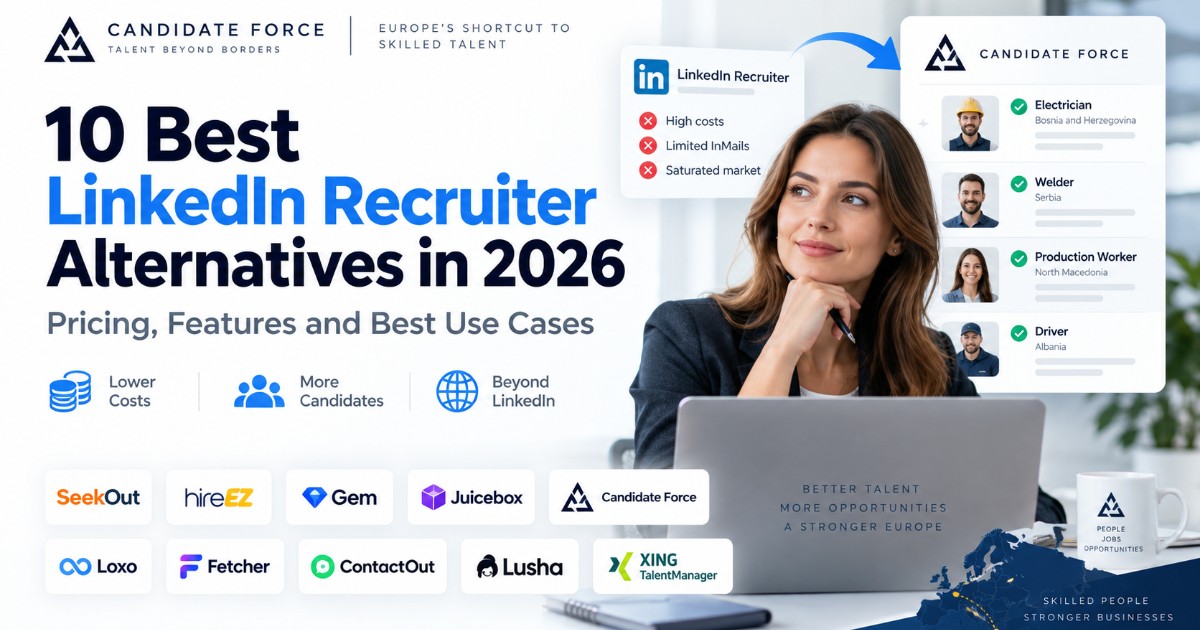
10 Best LinkedIn Recruiter Alternatives in 2026: Pricing, Features and Best Use Cases
LinkedIn Recruiter remains one of the most powerful sourcing tools for professional talent. Its combination of a massive professional network, detailed profiles, advanced filters and direct outreach is difficult to replicate with a single product.
But it is no longer the only serious option.
Recruiters searching for LinkedIn Recruiter alternatives usually have one of three problems: the license cost is difficult to justify, the available InMail volume does not match their sourcing needs or the candidates they need are not sufficiently active on LinkedIn.
The last point matters more than it may seem.
For software engineers, managers, sales professionals and corporate functions, LinkedIn can be exceptionally strong. For electricians, welders, mechanics, drivers, production workers, warehouse staff and other operational profiles, the picture can be different. Many workers either do not maintain a LinkedIn profile at all or maintain one with too little information to make it useful for sourcing.
That is why the best alternative depends heavily on who you are hiring.
A technology company looking for senior engineers has a different sourcing problem from a German manufacturer looking for 30 production workers. A recruitment agency working across dozens of clients needs a different workflow from a five-person company making three hires per year.
This guide compares ten of the most relevant alternatives to LinkedIn Recruiter in 2026 based on sourcing model, candidate coverage, pricing, outreach capabilities and the hiring scenarios where each product makes the most sense.
Pricing and product information below was checked in September 2026.
Why recruiters are looking for alternatives to LinkedIn Recruiter
Cost is usually the first trigger.
LinkedIn currently lists Recruiter Lite at $170 per month for one license or $1,680 annually. Teams purchasing between two and five Recruiter Lite licenses are shown higher per-seat pricing. Full LinkedIn Recruiter, Recruiter Professional Services and related enterprise products use custom pricing based on factors such as hiring volume, company size, geography and contract structure.
Messaging is another consideration. Recruiter Lite includes 30 InMail credits per month, while full Recruiter includes 150 monthly InMail credits per seat. Additional limits also apply to certain types of messaging and usage.
The third issue is less about product functionality and more about channel dynamics.
A recruiter may find thousands of technically relevant profiles but still compete with many other recruiters trying to contact the same people. In heavily recruited professional categories, candidate inbox saturation can make another database, direct email channel or specialist community valuable even when LinkedIn remains part of the stack.
And then there are roles where LinkedIn is simply not the natural home of the candidate population.
A welder in Bosnia, a forklift driver in Serbia or an automotive mechanic in North Macedonia may be actively looking for work in Germany while having little or no meaningful LinkedIn presence. In that scenario, searching a larger professional network does not necessarily produce a better shortlist.
That is why a modern sourcing strategy should optimize for relevant and reachable candidates, not the largest theoretical database.
If reducing LinkedIn dependency is your main goal, our guide How to Source Candidates Without LinkedIn Recruiter goes deeper into regional databases, job boards, referrals, community sourcing and other channels.
LinkedIn Recruiter alternatives compared
| PlatformBest forPricing snapshotMain advantage | |||
| SeekOut | Enterprise and broad professional sourcing | Recruit Core from $149/month annually | Large searchable profile base and AI sourcing |
| hireEZ | Automation and multi-channel sourcing | From $494/month for solo recruiters | Sourcing, CRM, outreach and automation |
| Juicebox / PeopleGPT | Startups and SMB sourcing | Free; Starter from $99/month annually | Natural-language AI search |
| CandidateForce | Skilled and operational workers from the Western Balkans | Free search and jobs; candidate unlocks from €25 | Access to candidates outside traditional LinkedIn-heavy sourcing |
| Gem | Recruiting teams wanting sourcing + CRM + ATS | Staffing plans from $99/user/month annually; broader in-house pricing varies | Strong end-to-end recruiting workflow |
| Loxo | Recruitment agencies and search firms | Core from $149/user/month annually | ATS, CRM, sourcing, outreach and AI in one platform |
| Fetcher | Teams wanting sourcing assistance and automation | Multiple self-serve and managed tiers | Combines technology with sourcing support |
| XING TalentManager | DACH recruiting | Company-specific annual pricing | Strong Germany, Austria and Switzerland focus |
| ContactOut | Recruiters needing contact data | Team/API pricing by quote | Email and phone enrichment |
| Lusha | Contact enrichment and outbound | Free tier plus credit-based paid plans | Simple email and phone data enrichment |
No single option replaces every LinkedIn Recruiter workflow. The strongest choice depends on whether you primarily need discovery, candidate contact data, automation, ATS functionality or access to a completely different candidate population.
1. SeekOut
Best for: Enterprise sourcing and professional talent discovery
SeekOut is one of the most direct competitors to LinkedIn Recruiter for recruiters who still want a large searchable professional talent universe but do not want sourcing to depend entirely on LinkedIn.
Its Recruit Core plan currently starts at $149 per month when paid annually or $179 when billed monthly. The plan includes unlimited searches, access to more than one billion profiles, AI search, 30+ filters, 500 monthly contact credits and 1,000 monthly exports.
That makes SeekOut particularly attractive for recruiters hiring technical, professional and specialist talent across several markets.
Where it differs from LinkedIn is the sourcing philosophy. LinkedIn begins with its own professional network. SeekOut is designed more like a talent search and intelligence layer spanning a broader range of information sources.
For organizations already using an ATS and needing stronger outbound sourcing, that can be a compelling combination.
Best fit: enterprise and mid-market teams sourcing professional, technical and specialist roles.
Potential limitation: teams primarily hiring operational workers may still need regional or occupation-specific channels alongside SeekOut.
2. hireEZ
Best for: Recruiting teams that want sourcing automation
hireEZ has evolved beyond being only a sourcing search engine. Its current product positioning combines candidate sourcing, CRM functionality, outreach and sequencing, AI screening, scheduling and recruiting analytics.
For individual recruiters, hireEZ currently states pricing starts at $494 per month with a seven-day trial. Enterprise pricing is configured around the recruiting stack and workflow being replaced rather than a simple public per-seat rate.
That makes hireEZ particularly relevant for larger sourcing operations where recruiter productivity matters as much as database access.
Rather than manually searching, exporting, enriching and sequencing candidates across multiple products, hireEZ is designed to consolidate more of that workflow.
Best fit: established talent acquisition teams and recruiters doing significant proactive sourcing.
Potential limitation: the entry price may be difficult to justify for small companies that only source occasionally.
For teams comparing the product specifically against other sourcing platforms, see our dedicated hireEZ Alternatives guide.
3. Juicebox / PeopleGPT
Best for: Startups and small teams that want AI-first sourcing
Juicebox is one of the more interesting LinkedIn Recruiter alternatives for small companies because the entry barrier is relatively low and the search interface is built around natural language.
Its PeopleGPT search lets recruiters describe the person they need rather than build complex Boolean queries.
Juicebox currently advertises a free plan. Starter costs $99 per seat per month on annual billing and includes unlimited searches, 500 monthly contact credits and 500 export credits. Growth costs $179 per seat per month annually and increases contact and export allowances to 1,500 per seat. Juicebox says its searchable dataset covers roughly 800 million profiles globally.
This is a strong proposition for a founder or recruiter who wants to say:
“Find me production managers in Bavaria with automotive experience and previous responsibility for teams of more than 50 people”
rather than manually construct a long filter sequence.
Best fit: startups, founders, boutique agencies and small recruiting teams sourcing professional talent.
Potential limitation: AI search makes discovery easier but does not automatically solve markets where the desired candidates have little digital professional data.
4. CandidateForce
Best for: Blue collar, skilled and operational hiring from the Western Balkans
CandidateForce is different from most products in this comparison because it is not trying to recreate LinkedIn's global professional graph.
It focuses on a narrower problem: helping European employers directly find and hire candidates from the Western Balkans.
That includes professions such as electricians, mechanics, welders, CNC operators, production workers, drivers, warehouse staff, construction workers and other skilled or operational profiles.
This matters because a significant part of this labor market cannot be effectively sourced by searching only professional networking platforms.
CandidateForce allows employers to search the candidate database, publish unlimited active jobs and invite candidates to opportunities without paying a subscription. Candidate contact details and the hiring workflow can then be unlocked using credits.
Current public pricing starts at €25 for a single candidate unlock, with lower effective prices available through credit packs. CandidateForce also offers an introductory Professional subscription at €490 per month for companies hiring continuously.
Its biggest difference from LinkedIn Recruiter is therefore not a feature.
It is the candidate population.
If you are looking for a senior SaaS sales executive in London, LinkedIn, SeekOut or Juicebox will probably make more sense.
If you are a German industrial company trying to find electricians, mechanics or production workers from Bosnia, Serbia or North Macedonia, CandidateForce addresses a sourcing problem that general professional networks often handle less efficiently.
Employers can also use the same platform for inbound and outbound recruiting: publish a vacancy, receive applications and proactively search for additional candidates.
Best fit: European employers and agencies hiring skilled and operational workers from Bosnia and Herzegovina, Serbia, Montenegro, North Macedonia, Kosovo and Albania.
Potential limitation: it is intentionally specialized. Companies looking primarily for global white-collar or executive talent should combine it with a broader professional sourcing platform.
This is also why CandidateForce can complement rather than necessarily replace LinkedIn. Use LinkedIn for professional profiles where it performs well and use a specialized regional database for candidate groups that are poorly represented there.
5. Gem
Best for: Teams that want sourcing, CRM, ATS and analytics together
Gem has moved well beyond its original reputation as a recruiting CRM and outreach tool.
The platform now includes AI sourcing, candidate relationship management, ATS functionality, scheduling, analytics and talent rediscovery. Gem states its AI sourcing capability operates across a database of approximately 800 million profiles.
For staffing and recruiting firms, Gem publishes transparent pricing. Essentials currently starts at $99 per user per month when billed annually, while Professional starts at $149 per user per month annually. Monthly billing is higher.
For in-house recruiting teams, pricing depends more heavily on company size and configuration. Gem also has a startup program with discounted or free introductory periods for eligible early-stage companies.
Gem is particularly attractive when the problem is not simply “we need another database.”
If sourcing, outreach, ATS workflows, scheduling and analytics are spread across five different systems, consolidation can be more valuable than adding another sourcing seat.
Best fit: sophisticated recruiting teams, staffing businesses and startups that want one broader recruiting platform.
Potential limitation: teams looking only for a lightweight candidate-search tool may not need the full platform.
6. Loxo
Best for: Recruitment agencies and executive search firms
Loxo is another alternative that approaches the problem as a complete recruiting operating system rather than just candidate sourcing.
Its Core plan currently starts at $149 per user per month billed annually and includes an ATS, recruiting CRM, AI search, unlimited jobs and candidates, reporting, email and calendar synchronization and related workflows.
Professional starts at $199 per user per month billed annually and adds Loxo Source, access to its stated 850M+ talent graph, contact information where available, its agentic workflow and 2,500 monthly credits per seat.
For agencies, this can remove the need to maintain separate ATS, CRM, sourcing, contact-data and outreach products.
Best fit: staffing firms, executive search companies and recruitment agencies managing substantial candidate and client workflows.
Potential limitation: organizations that already have a mature ATS and only need inexpensive sourcing may find the platform broader than necessary.
7. Fetcher
Best for: Teams that want sourcing technology plus human support
Fetcher sits somewhere between sourcing software and a sourcing service.
Its current plans combine a database of more than 500 million candidates with email outreach, CRM functionality, profile refreshes and higher-tier sourcing support. The public pricing page currently presents Self-Serve, Growth, Amplify and Enterprise packages and offers a 30% discount for annual payment, although exact dollar pricing is not exposed in the public page text we could verify.
The more interesting distinction is operational.
Some teams do not need another search interface. They need someone or something to consistently deliver candidates into the top of the funnel.
Fetcher is therefore worth considering when recruiter capacity is the bottleneck.
Best fit: smaller talent teams, companies with limited sourcing capacity and employers that want more sourcing assistance.
Potential limitation: teams that want full control over every search may prefer a pure self-service product.
8. XING TalentManager
Best for: German-speaking markets
For employers focused on Germany, Austria and Switzerland, XING TalentManager deserves consideration precisely because it is more geographically focused than LinkedIn.
TalentManager includes advanced candidate search, Boolean search, candidate recommendations, talent pools and direct candidate messaging.
The Core version allows up to 200 messages to non-contacts per month, or 300 for HR consulting agencies. The Pro version provides broader messaging access, with a stated 1,000-message monthly limit for HR consulting agencies. Pricing is calculated based on company requirements and is sold on an annual basis.
For companies hiring primarily in DACH, using both LinkedIn and XING can also reveal candidates who are more active on one network than the other.
Best fit: German, Austrian and Swiss professional recruiting.
Potential limitation: the geographic focus makes it less relevant for teams sourcing globally.
9. ContactOut
Best for: Finding candidate email addresses and phone numbers
ContactOut is less of a direct LinkedIn Recruiter replacement and more of a useful sourcing-stack component.
The platform provides a search portal, browser extension, contact enrichment, email campaigns, integrations and access to professional contact information.
ContactOut states its team offering covers a database of more than 700 million profiles and includes Salesforce and ATS integrations. Current team and API pricing is quote-based.
Its value is clearest when candidate discovery is not the problem.
You may already find the person through LinkedIn, a company website, GitHub or another database but need another way to contact them.
Instead of relying entirely on InMail, ContactOut can help recruiters move outreach to email or phone where appropriate.
Best fit: sourcers and agencies that already have discovery channels but need additional contact enrichment.
Potential limitation: contact data alone does not provide the full sourcing, ATS or candidate-management workflow offered by broader platforms.
10. Lusha
Best for: Simple contact enrichment
Lusha is widely used as a sales-intelligence platform but the same contact-data capabilities can support recruiting workflows.
Its pricing uses credits. A verified email costs one credit and a phone number five credits. Lusha currently offers a free plan with up to 40 credits per month, while higher tiers provide more credits, seats and integrations.
For recruiters, Lusha makes the most sense as an enrichment layer rather than a complete LinkedIn Recruiter substitute.
Find the candidate somewhere else, then use contact intelligence to expand how you can approach them.
Best fit: small teams that need occasional email or phone enrichment.
Potential limitation: it is fundamentally a contact-data product rather than a complete recruitment sourcing platform.
Best LinkedIn Recruiter alternatives for small and mid-sized companies
SMBs should be especially careful about buying sourcing software based on database size alone.
A five-person company making ten hires per year does not need the same infrastructure as an enterprise talent acquisition department with 50 recruiters.
For professional hiring, Juicebox is one of the easiest starting points because its Starter plan is inexpensive relative to many enterprise sourcing tools and includes both AI search and contact credits. SeekOut Recruit Core is another strong option when broader professional search depth is more important.
For startups that also need an ATS and recruiting workflow, Gem becomes more interesting because its startup pricing is structured specifically around smaller organizations.
For operational and skilled-worker hiring from the Western Balkans, CandidateForce has a fundamentally different cost structure. Companies can search candidates and post jobs without paying a monthly subscription, then pay when they decide to move a specific candidate into the process.
That can be economically attractive for companies that hire irregularly.
A business that needs five electricians today but may not recruit again for four months may prefer paying per candidate over carrying a sourcing license continuously.
The key question for an SMB is therefore not:
Which platform has the biggest database?
It is:
Which platform contains enough of the candidates we actually hire without forcing us to pay for infrastructure we rarely use?
Best alternatives for recruitment agencies
Agencies have a different problem because sourcing volume is higher and the same recruiter may work across many clients simultaneously.
That makes workflow management important.
Loxo is particularly relevant here because sourcing, ATS, CRM and outreach live in the same system. Gem also offers agency-specific plans with sourcing, candidate management and multi-channel outreach.
hireEZ becomes attractive when automation and sourcing volume are the priority.
For agencies placing skilled workers into Europe, CandidateForce can be used as a specialist sourcing layer alongside the agency's existing ATS, especially when client demand includes Western Balkan talent.
The best agency stack may therefore contain more than one source.
A broad professional sourcing platform can cover white-collar vacancies while CandidateForce, job boards and regional networks cover operational hiring.
Best LinkedIn alternatives for blue collar and non-LinkedIn candidates
This is the area where comparing every product purely by database size becomes misleading.
Blue collar sourcing often depends on different information.
An employer hiring a truck driver may care about C or CE licensing, Code 95, international driving experience, availability and willingness to relocate.
A factory recruiting CNC operators needs machine experience, control systems, shift willingness and technical experience.
A construction employer may need electricians, welders, installers or machine operators who are rarely optimizing their online professional profiles for recruiter discovery.
The sourcing channel therefore needs to match the worker population.
For Western Balkan skilled workers, CandidateForce is the most specialized product in this comparison.
For DACH candidates, local networks such as XING and regional job boards may contribute additional reach.
For large-scale operational recruitment, community sourcing, local job portals, referrals and specialist databases can often produce better results than sending more InMails to the same professional network.
This does not make LinkedIn ineffective.
It means LinkedIn coverage is not evenly distributed across every occupation.
A good sourcing team should measure this rather than assume it.
Cheaper alternative to LinkedIn Recruiter: what should you actually compare?
The cheapest subscription is not necessarily the cheapest sourcing channel.
Suppose Tool A costs $100 per month and produces two qualified conversations.
Tool B costs $500 and produces twenty.
Tool B is five times more expensive as software but dramatically cheaper per recruiting outcome.
The metric worth tracking is:
Annual sourcing cost ÷ qualified candidate conversations
Then measure cost per interview and cost per hire.
Also include recruiter time.
If a cheaper platform forces recruiters to manually search five different websites, enrich every profile and send outreach individually, the labor cost can exceed the software saving.
Likewise, a premium LinkedIn Recruiter contract may be entirely rational if it consistently fills difficult roles.
The goal is not to find the cheapest alternative to LinkedIn Recruiter.
The goal is to find the lowest-cost repeatable path to qualified candidates.
Should you replace LinkedIn Recruiter completely?
Usually, no.
The stronger strategy is diversification.
Keep LinkedIn where LinkedIn performs well.
Add SeekOut, Juicebox, Gem or hireEZ where broader professional sourcing and automation improve the workflow.
Use XING where DACH-specific professional coverage matters.
Add ContactOut or Lusha where contact enrichment is the missing layer.
Use specialist sources such as CandidateForce when the target candidate population is not well represented in professional networks.
That gives recruiters multiple ways to reach the market instead of depending on one algorithm, one message channel and one candidate database.
For a broader channel strategy, see 10 Channels Beyond LinkedIn and our guide How to Source Candidates Without LinkedIn Recruiter. For platform-specific comparisons, our hireEZ Alternatives and SeekOut Alternatives guides go deeper into those ecosystems.
How to choose the right LinkedIn Recruiter alternative
Start with the candidate rather than the software.
If your ideal candidate is a senior professional with a detailed online career history, prioritize broad professional databases and AI sourcing.
If your problem is recruiter productivity, prioritize automation, sequences and ATS integration.
If you are an agency, prioritize candidate management, client workflows and reusable talent pools.
If you recruit electricians, mechanics, drivers, welders or production workers internationally, prioritize the channels where those people actually register and search for jobs.
And if cost is the reason you are leaving LinkedIn, do not compare monthly subscription numbers in isolation.
Run the competing tools against the same real vacancy.
Measure relevant candidates found, usable contact information, positive responses, qualified conversations, interviews and hires.
The winning platform will become obvious much faster than it will from a feature matrix.
Frequently Asked Questions
What is the best LinkedIn Recruiter alternative?
There is no universal replacement. SeekOut is one of the strongest broad professional sourcing alternatives, hireEZ is strong for automation, Juicebox is attractive for AI-first SMB sourcing, Gem and Loxo provide broader recruiting platforms and CandidateForce is purpose-built for sourcing skilled and operational candidates from the Western Balkans.
What is a cheaper alternative to LinkedIn Recruiter?
Juicebox starts at $99 per seat per month on annual billing, while SeekOut Recruit Core starts at $149 per month annually. CandidateForce can be used without a monthly subscription, with paid candidate unlocks starting at €25. Actual value depends on candidate fit and hiring volume.
How much does LinkedIn Recruiter cost?
LinkedIn lists Recruiter Lite at $170 per month for a single license or $1,680 annually, with pricing varying by region and currency. Full Recruiter products use custom pricing based on the organization and contract.
What are the best LinkedIn Recruiter alternatives for small companies?
Juicebox, SeekOut Recruit Core, CandidateForce and Gem can all make sense for smaller companies depending on the roles being hired. Juicebox and SeekOut are strongest for professional sourcing, CandidateForce for Western Balkan skilled and operational candidates and Gem when the company also needs broader ATS and recruiting workflow functionality.
Which sourcing tools are like LinkedIn?
SeekOut, hireEZ, Juicebox, Gem, Loxo and XING TalentManager all provide forms of proactive candidate search. Their underlying data sources and workflows differ, so they should not be treated as identical LinkedIn substitutes.
What is the best LinkedIn alternative for blue collar recruitment?
Specialized databases, regional job portals and candidate communities are usually more relevant than generic professional networks for many blue collar roles. CandidateForce is specifically designed for European employers sourcing skilled and operational workers from the Western Balkans.
Can recruiters source candidates without LinkedIn?
Yes. Recruiters can combine searchable talent databases, ATS rediscovery, job boards, regional marketplaces, referrals, professional directories, community channels and direct email sourcing. Our How to Source Candidates Without LinkedIn Recruiter guide covers eight practical approaches in detail.
Final thoughts
LinkedIn Recruiter remains an important sourcing platform in 2026, especially for professional and management hiring.
But recruiting teams no longer need to build their entire sourcing strategy around one network.
SeekOut provides broad professional search. hireEZ adds automation. Juicebox makes AI sourcing accessible to smaller teams. Gem and Loxo consolidate more of the recruiting stack. XING provides another route into the DACH professional market. ContactOut and Lusha expand contact options.
And CandidateForce addresses a different sourcing gap altogether: helping European employers directly access skilled and operational candidates from the Western Balkans who may never appear prominently in a LinkedIn Recruiter search.
The best sourcing stack is therefore not the one with the longest feature list.
It is the one that reaches the people you actually need to hire.
CandidateForce lets employers search candidates, publish jobs and start building a Western Balkan talent pipeline for free. You only need to pay when you decide to move forward with a candidate.